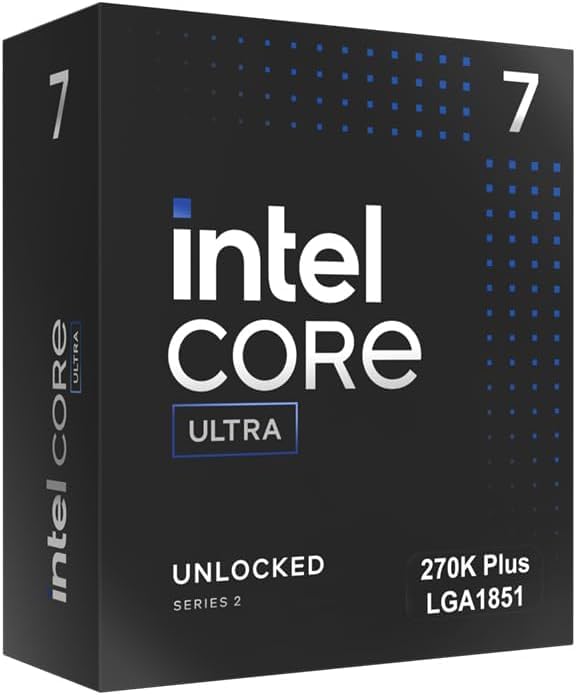

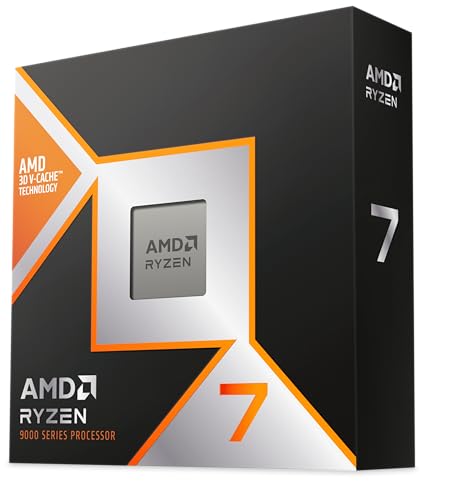
The 270K Plus is what the original Arrow Lake 200-series should have been at launch. Same socket, same architecture, same chipset compatibility — but with higher boost clocks, native DDR5-7200, Intel Binary Optimization, and the firmware fixes that should have shipped 18 months ago. The headline question buyers actually have isn't "is it faster than the 265K?" — it is, by a meaningful margin in mixed workloads. The question is "is it faster than the Ryzen 7 9800X3D?" The honest answer: not in games, but maybe in everything else, and at $299 vs $479 the value math gets interesting fast.
Intel Core Ultra 7 270K Plus
24 cores (8 P + 16 E) · 5.5 GHz boost · 36 MB L3 · LGA1851 · 125 W base / 250 W turbo · $299
The headline pick for Intel's refreshed lineup. Same socket as the original 200-series, but Intel finally fixed the launch issues — and added enough productivity throughput at the $299 price point that it's a serious alternative to the Ryzen 7 9800X3D for buyers who do anything beyond pure gaming.
- 24 cores at $299 is a productivity bargain
- Native DDR5-7200 closes the memory-bandwidth gap
- LGA1851 platform is stable now that microcode is patched
- Still loses to the 9800X3D in pure-gaming benchmarks
- Higher idle and load power than AMD competitors
- Arc Xe-LPG iGPU (64 EU) is fine for diagnostics but not actual gaming
Tom's Hardware rates it Intel's fastest gaming chip; that doesn't make it the fastest gaming chip overall (the 9800X3D still wins games where the X3D cache helps), but for mixed gaming + creator workloads it's the cleanest choice in this price tier. The 250 W max turbo power is what unlocks the productivity case — sustained Cinebench R23 puts the 24-core configuration well ahead of the 8-core 9800X3D in any thread-scaled benchmark.
Intel Core Ultra 5 250K Plus
18 cores (6 P + 12 E) · 5.3 GHz boost · 30 MB L3 · LGA1851 · 125 W base / 159 W turbo · $199
Tom's Hardware called this "the new best $200 CPU"; GamersNexus' summary was that the chip "matches the competition in gaming and absolutely runs circles around other chips in applications." 18 cores at $199 is a productivity floor that the Ryzen 5 7600 (6 cores at the same price) can't approach.
- Genuinely best-in-class productivity at the $200 mark
- Same DDR5-7200 platform support as the 270K Plus
- Phoronix's Linux review highlighted exceptional code-compile and scientific value
- Pure-gaming buyers still get more from a Ryzen 5 7600 ($180) or 7800X3D
- Lower turbo power (159 W) caps sustained throughput vs the 270K Plus
Where AMD wins this price bracket is gaming — the Ryzen 7 7800X3D at $299 still beats both for pure FPS-bound titles. But the 250K Plus is the new default productivity recommendation for buyers who need 18 cores of compute and not 8 cores of cache.
The numbers.
| 270K Plus | 250K Plus | 9800X3D (ref.) | |
|---|---|---|---|
| Cores / threads | 24 (8 P + 16 E) / 24 | 18 (6 P + 12 E) / 18 | 8 / 16 |
| P-core boost | 5.5 GHz | 5.3 GHz | 5.2 GHz |
| L3 cache | 36 MB | 30 MB | 96 MB (3D V-Cache) |
| TDP base / turbo | 125 / 250 W | 125 / 159 W | 120 W |
| Memory | DDR5-7200 | DDR5-7200 | DDR5-5600 (6000 OC) |
| Socket | LGA1851 | LGA1851 | AM5 |
| iGPU | Arc Xe-LPG 64 EU | Arc Xe-LPG 64 EU | Radeon 2-CU |
| MSRP | $299 | $199 | $479 |
| Strength | Mixed gaming + creator | Best $200 productivity | Pure gaming king |
Other strong options.
Intel Core Ultra 9 290K Plus
The flagship of the Plus refresh — 24 cores like the 270K Plus but with higher binning and higher boost clocks at ~$599. For most buyers it's a poor value vs the 270K Plus; for buyers who specifically need maximum single-thread performance for 1% lows in CPU-bound games or top-end productivity, it's the option.
AMD Ryzen 7 7800X3D
Within 5% of the 9800X3D in games at $150 less. The smart-money pure-gaming pick if you can find one at street price. AM5 socket means a 9800X3D drop-in upgrade later if you want it.
AMD Ryzen 9 9950X
16 cores, no X3D cache. The productivity-first AMD answer to the 270K Plus. ~$549. Wins pure thread-scaled benchmarks but at significantly higher price than the Intel chip.
The buying guide.
Buy the 270K Plus if
You game *and* also do significant productivity (content creation, code, Blender, streaming). You want the best Intel chip available without paying Core Ultra 9 285K money. You're committed to LGA1851 — already own a Z890/B860 board, or want Intel's specific platform features like USB4 + Thunderbolt.
Buy the 250K Plus if
You want the best productivity-per-dollar at $200. You do code compile, scientific computing, or Linux workloads (where 18 cores really shines). Pure gaming isn't the priority but you want decent gaming performance as a bonus.
Don't buy either if
You game and only game — the 9800X3D is still the right answer at any price. You already own a Core Ultra 200-series chip — the upgrade gain isn't worth the cost. You're invested in AM5 — switching platforms means new motherboard + RAM, killing the chip-vs-chip price comparison.
Platform requirements
Both Plus chips require an LGA1851 motherboard with Intel 800-series chipset — Z890, B860, or H810. LGA1700 boards (Z790, B760, H770) do not work; the socket changed with the 200-series. Most LGA1851 boards from late 2024 onward are compatible after a BIOS update.
FAQ.
Yes, with a BIOS update. Every Z890 / B860 / H810 board released since late 2024 supports the Plus refresh after flashing to current firmware. Most retail boards in 2026 ship with current BIOS; if yours doesn't, the BIOS Flashback feature on most Z890 boards lets you update without a CPU installed.
It's a real thing — a firmware-level instruction-scheduling tweak — but the gains are modest, typically 2–5% in supported workloads. It's not a generation-changing feature; it's a refinement that the original 200-series can't access.
Yes-ish. 250 W max turbo power means a 240 mm AIO minimum; a 360 mm AIO or flagship dual-tower air cooler (NH-D15 G2 class) for sustained workloads. Compared to the 9800X3D's 120 W TDP, the 270K Plus needs roughly twice the cooling capacity to extract its full potential.
No. LGA1851 / Intel 800-series chipsets are DDR5-only. There is no DDR4 path on this platform.
For most buyers, yes — the Plus's microcode and IBO improvements close most of the gap with the 285K, and the 270K Plus costs significantly less. The Core Ultra 9 285K still wins peak single-thread benchmarks, but the value proposition of the 270K Plus is much stronger.
For Intel buyers: the 270K Plus.
For pure gaming: the 9800X3D still wins.
For best $200 CPU: the 250K Plus.
The Plus refresh is what the 200-series should have been at launch. Significantly more capable than the chips it replaces, on a stable platform, with native DDR5-7200 support that closes the memory-bandwidth gap. Intel needed this launch to land. It did.