

Picking headphones for a desktop is a different problem than picking them for a phone. The phone version optimizes for portability, battery life, and Bluetooth pairing speed. Desktop use cares about different things: how the headphones connect (USB DAC, 3.5 mm into your motherboard, or wireless dongle versus Bluetooth latency), whether the mic is good enough for daily Zoom or Discord without a separate microphone, whether the ear cups stay comfortable for an eight-hour session, and whether there's a meaningful upgrade path with a dedicated headphone amplifier. The four picks below cover four jobs people use a PC for: general daily use across music, calls, and casual gaming; competitive gaming; calls-first work-from-home; and music listening when you care about the music. Each main pick is paired with two cheaper alternatives so the article works at $30 and $500 budgets. We've stuck to long-stable models with solid Amazon listings, not 2026 launches that may disappear by Q4.
Sony WH-1000XM5
Wireless · Bluetooth 5.2 + USB-C · ANC · 30-hr battery · 30 mm driver
The default answer for most desktops. ANC that beats anything in this price tier, a mic that holds up on calls, and a USB-C wired mode for when you want zero latency on PC.
- ANC quality holds up across the full battery range
- USB-C wired mode bypasses Bluetooth latency for PC gaming
- Mic handles Zoom and Discord without an external solution
- Multipoint Bluetooth pairs phone and PC simultaneously
- Less foldable than the WH-1000XM4, harder to bag-pack
- No 3.5 mm jack on the headphones, the included cable is 3.5 mm to USB-C
- Touch controls misfire occasionally in cold weather
The WH-1000XM5 is the headphones most desktop users should buy and not feel constrained. The ANC is the headline (Sony's V1 + QN1 chip combo measures within a couple dB of the AirPods Max in independent tests at half the price), but the underrated feature for desktop use is the USB-C wired mode. Plug into a motherboard USB port and the headphones bypass Bluetooth entirely, eliminating the 60-200 ms input lag that makes wireless headphones unviable for competitive gaming. Battery is 30 hours on Bluetooth, multipoint pairing handles phone and PC at the same time, and the built-in mic clears the bar for daily calls without needing a boom or USB microphone. Comfort holds up over eight-hour sessions; the ear cups breathe better than the AirPods Max and the M4 generation.
SteelSeries Arctis Nova Pro Wireless
Dual battery · 2.4 GHz USB-C dongle + Bluetooth · 40 mm driver · ClearCast Gen 2 retractable mic
The gaming headset for people who hate gaming headsets. Two swappable batteries (one in the headset, one charging in the base station), 2.4 GHz dongle for zero-latency PC, plus Bluetooth that runs at the same time for phone calls.
- Hot-swap battery means the headset is never out of power
- Dual-wireless lets you keep PC audio + phone audio simultaneously
- Retractable boom mic is on par with $100 standalone USB mics for Discord
- Base station has its own DAC, your motherboard audio doesn't matter
- Premium price, $329 MSRP versus $130 for a typical Cloud III
- ANC is present but weaker than the WH-1000XM5
- Sonar software is Windows-only, Linux loses EQ profiles
Most gaming headsets ask you to choose between low-latency 2.4 GHz wireless for PC and Bluetooth for everything else. The Arctis Nova Pro Wireless runs both at the same time. Your PC audio stays on the 2.4 GHz dongle (sub-20 ms latency, equivalent to wired), Discord voice rides the same connection, and Bluetooth picks up your phone calls in parallel. The base station holds a charging dock for the spare battery, so when the headset dips below 20% you swap in 5 seconds and never plug a cable. The ClearCast Gen 2 retractable mic is the other reason serious PC gamers pick this over the WH-1000XM5; boom mics sit closer to the mouth and reject room noise better than the embedded mics in consumer headphones. For PC gaming specifically, this is the only consumer wireless option that doesn't ask you to compromise.
Jabra Evolve2 75
Wireless · Bluetooth 5.2 + USB dongle · 8-mic array · 36-hr battery · Teams certified

The headset IT departments standardize on for a reason. Eight-microphone array reduces room noise on Zoom and Teams better than any consumer headphone in this tier. The trade-off: audio quality is tuned for voice, not music.
- Mic array isolates voice from background noise in any office or cafe
- Plug-and-play certified with Microsoft Teams, Zoom, Webex
- Hidden boom mic means it looks like a normal pair of headphones in meetings
- Long-session comfort beats most premium consumer ANC headphones
- Music playback is tuned for voice clarity, bass is thin
- No multipoint Bluetooth on the base model, add the link cost for it
- Premium price ($299) and you're paying for the mic, not the speakers
If your PC is mostly for work calls, this is the headset to buy and stop thinking about audio. The eight-microphone array is the differentiator. Most premium consumer headphones (WH-1000XM5 included) use two or three mics for voice pickup; the Evolve2 75 uses eight, with beamforming that locks onto your voice and rejects everything else. The result: the person on the other end of the call hears your voice cleanly with no background noise gate clipping syllables. Battery is 36 hours, the boom mic slides discreetly into the headband when not in use so the headset doesn't scream 'call center,' and the USB dongle is plug-and-play with Teams and Zoom. The trade-off is music. The speakers are good but tuned for voice frequencies; bass is thin compared to consumer cans at the same price. If you spend 6 hours a day on calls and 1 hour listening to music, this is correct. Reverse those numbers and look at the daily driver pick.
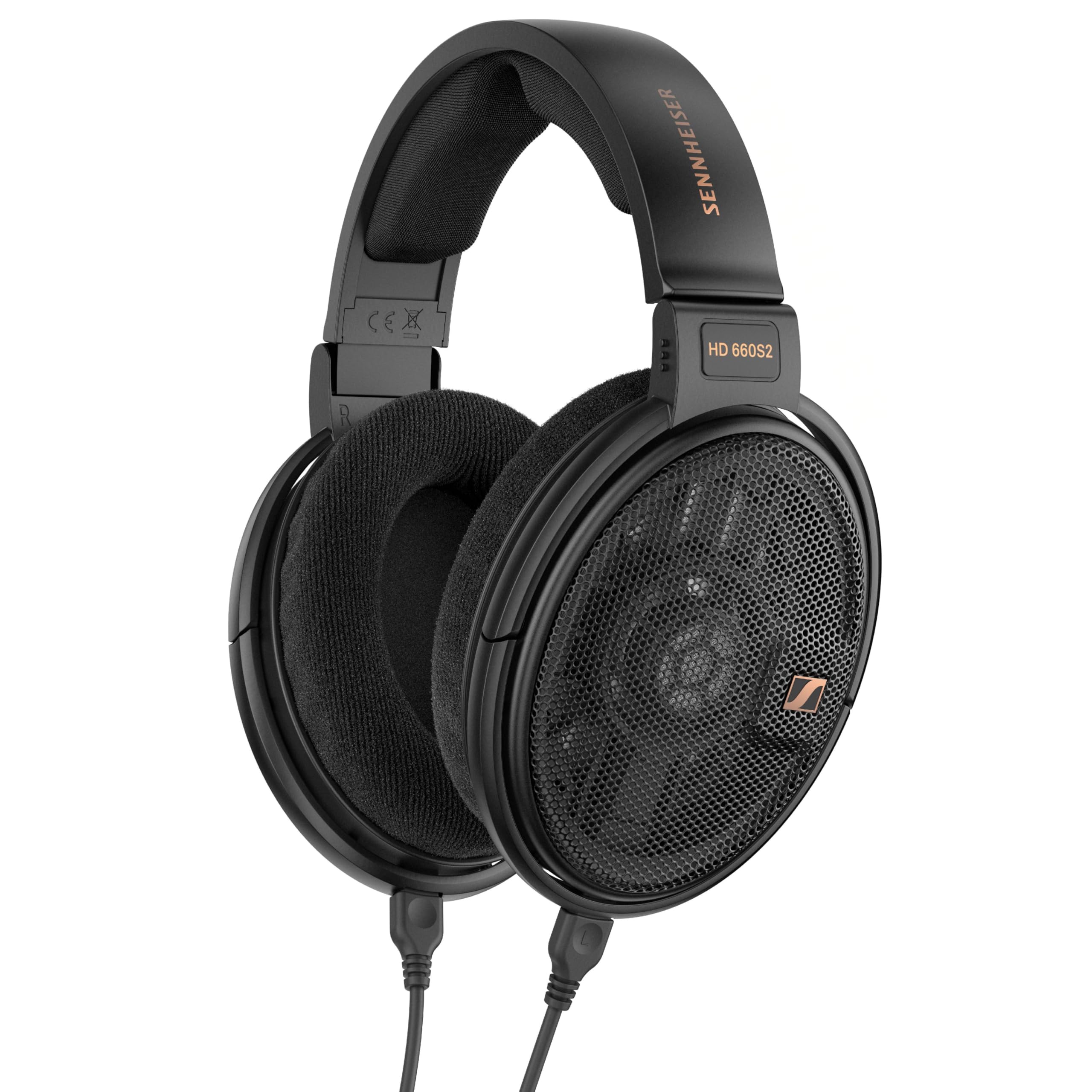
Sennheiser HD 660S2
Wired · Open-back · 300 ohm · 6.3 mm + 4.4 mm balanced cables · 260 g
The desktop reference. Open-back design gives a soundstage no closed headphone matches, 300-ohm drivers reward a real headphone amp, and the build will outlast three rounds of consumer headphones.
- Soundstage and imaging that closed headphones cannot replicate
- 300-ohm impedance gives a real upgrade path with better amps
- Velour ear pads stay cool over multi-hour listening sessions
- Replaceable cable and ear pads, this is a 10-year purchase
- Open-back leaks sound, not for shared offices or noisy rooms
- Needs a dedicated amp or DAC, motherboard audio won't drive 300 ohms cleanly
- No mic, you need a separate microphone for calls and gaming
This is the pick for the desk where the headphones are mostly for music and the room is quiet enough to use them. Open-back means the back of the ear cup is mesh, not solid plastic, which lets the drivers breathe and produces a soundstage closer to listening to speakers in a room than to headphones strapped to your head. The trade-off is acoustic isolation: open-backs leak sound out (your roommate or partner will hear what you're listening to) and let sound in (a noisy room ruins the experience). At 300 ohms, motherboard audio cannot drive these properly. You need a headphone amp or DAC, the FiiO K7 ($200) or Topping DX3 Pro+ ($250) are the standard pairings and round out a sub-$1000 reference desk setup. The HD 660S2 succeeds the discontinued HD 660S with tighter bass response and a slight efficiency improvement, but the family lineage traces back to the HD 580 in 1993; the design is well understood and parts are replaceable. This is the audiophile pick that doesn't require a four-figure budget.
The numbers.
| WH-1000XM5 | Arctis Nova Pro | Jabra Evolve2 75 | HD 660S2 | |
|---|---|---|---|---|
| Connection | BT 5.2 + USB-C | 2.4 GHz + BT | BT + USB dongle | Wired 3.5/6.3 mm |
| Best for | Music + calls + casual gaming | PC gaming + phone parallel | Voice calls, Zoom, Teams | Music listening |
| Mic | Embedded, good | Retractable boom, great | 8-mic array, best on calls | None included |
| ANC | Best in test | Yes, weaker | Yes | No (open-back) |
| Battery | 30 hr | 22 hr × 2 hot-swap | 36 hr | n/a (wired) |
| Latency on PC | Low (USB-C wired) | Sub-20 ms (2.4 GHz) | Low (USB dongle) | Zero (wired) |
| Needs amp | No | No | No | Yes, 300 Ω |
| Price | $330 | $330 | $299 | $500 |
Other strong options.
Anker Soundcore Space Q45
Budget ANC daily driver at $100. The ANC isn't WH-1000XM5 quality but it's competitive with the Sony WH-CH720N at a third the price. USB-C wired mode included, multipoint Bluetooth, 50-hour battery. The right pick for daily use under $150.
View on Amazon →HyperX Cloud III
Budget wired gaming standard at $90. Detachable boom mic on par with the Arctis Nova Pro for Discord, 53 mm drivers, USB-A or 3.5 mm. No wireless and no fancy software, just durable hardware that handles 8-hour gaming sessions. The pick if the Arctis Nova Pro is overkill.
View on Amazon →Corsair HS55 Wireless
Budget wireless gaming at $80. 2.4 GHz USB dongle for low-latency PC, Bluetooth as a second connection, lightweight at 266 g. Mic isn't broadcast-grade but works for in-game comms. Compromises on ANC and software, but the only sub-$100 wireless gaming option worth recommending.
View on Amazon →Logitech Zone Vibe 100
WFH at $120. Multipoint Bluetooth (no USB dongle, no Teams cert), flip-to-mute boom mic, 18-hour battery. Less mic performance than the Jabra but a quarter cheaper. The pick if you take calls but Teams certification isn't a hard requirement.
View on Amazon →Philips SHP9500
Audiophile entry at $85. Open-back, 32-ohm so motherboard audio drives them fine, 50 mm drivers. The community-favorite gateway open-back, frequently EQ-modded toward HD 660S2 territory for under $100. Worse build than the Sennheiser but 1/6 the price.
View on Amazon →Beyerdynamic DT 770 Pro (80 Ω)
Studio classic at $160. Closed-back, 80-ohm version drives off most motherboard audio, velour pads, the standard tracking and mixing headphone for two decades. Bass-forward signature, replaceable pads. The pick for music when you can't use open-back (shared office, noisy room).
View on Amazon →Audio-Technica ATH-M50x
Closed-back budget at $130. Studio-monitor staple, 38-ohm so any source drives it, detachable cables, folds flat. The most reviewed headphone on Amazon for a reason: it's been a price-to-performance reference since 2014. Solid for music and casual gaming, mediocre soundstage.
View on Amazon →Sennheiser HD 600
The HD 660S2's older sibling at $330. Same family lineage, 300-ohm impedance, slightly brighter signature and lighter bass than the 660S2. Production has run since 1997 with the same design; parts are universally available. If the 660S2 stretches the budget, this is the textbook open-back at $170 less.
View on Amazon →The buying guide.
Wired versus wireless
For desktop use, wireless is a convenience choice, not a sound-quality choice. Bluetooth introduces 60-200 ms of latency that ruins competitive gaming and creates noticeable lip-sync drift on video. A 2.4 GHz dongle (Arctis, HyperX, Corsair) cuts that to sub-20 ms, effectively wired. A USB-C cable into a wireless headphone (WH-1000XM5) bypasses the radio entirely. Wired headphones are the only zero-latency option and the only way to use audiophile open-backs that need amplification.
Open-back versus closed-back
Open-back ear cups let air and sound flow through the back of the driver. Soundstage opens up dramatically, music sounds more like speakers in a room. The cost is leakage: your roommate hears your music, and a noisy room ruins isolation. Closed-back ear cups seal the driver, isolating from external noise and keeping audio in. Closed is mandatory in shared offices or with anyone in the room; open is the better music-listening experience in a quiet space.
Do you need a DAC or amp
For most consumer headphones (32-80 ohm impedance, sensitivity above 95 dB), motherboard audio is fine. Modern X870 and Z890 boards ship with Realtek ALC4080 or ESS Sabre DAC, equivalent to a $50 USB DAC. You need an external DAC or headphone amp when impedance climbs above 100 ohms (HD 660S2 at 300 ohm, DT 990 Pro 250 ohm) or when sensitivity drops below 90 dB. The FiiO K7 ($200) and Topping DX3 Pro+ ($250) cover both jobs and are the standard sub-$300 desktop solutions.
Mic considerations
Embedded mics in consumer headphones (WH-1000XM5) handle Zoom and Discord adequately but pick up room noise more than a boom mic. Retractable boom mics on gaming headsets (Arctis, HyperX Cloud) sit close enough to the mouth to reject room noise and approach $100 USB mic quality. Dedicated UC headsets (Jabra Evolve2) go further with beamforming arrays. If you spend more than 2 hours a day on calls, prioritize a boom or UC headset; if calls are occasional, an embedded mic is fine.
Comfort for long sessions
Eight-hour wear flips the cost calculation. Velour ear pads (HD 660S2, DT 770 Pro) breathe and stay cool. Pleather pads (WH-1000XM5, M50x) seal better for isolation but build heat. Headphone weight matters above 350 g, the Arctis Nova Pro at 338 g and the WH-1000XM5 at 250 g are pleasant for full days; the HD 660S2 at 260 g is the lightest of the picks. Replaceable ear pads (Sennheiser, Beyerdynamic) mean a $30 pad swap every two years instead of replacing the whole headphone.
FAQ.
No, not well. Standard Bluetooth introduces 60-200 ms of latency between the game audio and your ears, enough to ruin positional audio in FPS games. Use a 2.4 GHz dongle (Arctis Nova Pro, HyperX Cloud III Wireless) or a USB-C wired connection (WH-1000XM5 has this) for sub-20 ms latency. aptX Low Latency Bluetooth claims sub-40 ms but is rarely supported on PC motherboards.
For casual Zoom and Discord, no, the embedded mics handle it. For streaming, podcasting, or 4+ hours of daily calls, yes, add a USB mic ($60-150) or pick a headset with a boom mic. Embedded mics pick up keyboard noise and room reverb that beamforming on a separate mic rejects.
At 300 ohms impedance, motherboard audio outputs run out of voltage before the headphones reach normal listening volume. The drivers play but sound thin and quiet, not their actual character. A headphone amp (FiiO K7, Topping A30 Pro) provides the voltage the drivers need. 32-80 ohm headphones don't have this problem; motherboard audio drives them fine.
Only if you spend most of your PC time on calls. The Jabra's 8-mic array genuinely reduces room noise more than the Logitech's 2-mic setup, and Teams certification means it works correctly with corporate IT. For 1-2 hours of daily calls, the Logitech is sufficient and 60% cheaper.
Closed-back. Open-back leaks sound in both directions: your music annoys family or colleagues, and a baby crying or doorbell ringing destroys the soundstage. Save open-backs (HD 660S2, SHP9500) for dedicated quiet listening time. WH-1000XM5 and DT 770 Pro are the closed-back picks here.
For most desks: the WH-1000XM5.
For PC gaming: the Arctis Nova Pro Wireless.
For calls: the Jabra Evolve2 75.
For music: the HD 660S2.
There is no single best headphone for PC use. Pick the use case that dominates your day, buy the pick for that lane, and the article works at $30 and $500 depending on which alternative you fall back on. The expensive mistake is buying premium gaming-branded headphones for general use, or premium consumer headphones for serious gaming. The right tool for the right desk is cheaper than the wrong tool at any price.