


The GPU market in May 2026 is the strangest it has been since 2021. RTX 50-series cards launched in early 2025, AMD's RX 9000 series followed in March 2026, and Intel's Arc B580 (late 2024) turned the budget tier upside down. None of that would have produced much chaos on its own, but tariffs on Chinese-assembled electronics added 10-30 % to most card prices through 2026, and the [DDR5 RAM crisis](/reviews/ram-price-crisis-2026/) is making whole-system builds 20-30 % more expensive than they were a year ago. The result: every tier of the lineup has shifted. The $400 card of 2024 is the $550 card of 2026. The $700 sweet spot is closer to $800. And the $1,500 high-end now flirts with $1,800. What follows is what we would buy at four price points right now, based on real availability and street pricing this week, not MSRP listed somewhere.
ASRock Steel Legend Radeon RX 9070 XT
RDNA 4 · 16 GB GDDR6 · 4096 stream processors · 304 W TBP · 2 × 8-pin
AMD's first credible answer to NVIDIA at this tier in years. Raster performance trades blows with the RTX 5070 Ti, ray tracing closed to 10-15 % of NVIDIA's at the same tier from the 30-40 % gap RDNA 3 left behind, and the card sells for $50-150 less than the equivalent GeForce.
- 16 GB VRAM at a price NVIDIA won't match until RTX 5060 Ti 16 GB
- RDNA 4 closes the ray-tracing gap to within driver-update distance of NVIDIA
- Better raster performance per dollar than any RTX 50-series card under $1,000
- Standard 8-pin power, no 12VHPWR melting risk
- DLSS 4 still leads FSR 4 in quality, especially with Multi Frame Generation
- Sells out the second a restock lands; expect to pay $50-100 over MSRP
- CUDA-locked workloads (Blender, some AI) still favor NVIDIA
The story this generation is that AMD shipped a card that gives NVIDIA a fight at the upper-midrange. The 9070 XT matches or beats the RTX 5070 Ti in pure raster across most 1440p and 4K-medium tests (TechPowerUp, Hardware Unboxed), and RDNA 4 brought ray-tracing throughput up from the embarrassing RDNA 3 baseline to within 10-15 % of Ada / Blackwell. NVIDIA's edge here is DLSS 4 with Multi Frame Generation, a tangible image-quality advantage in supported games, plus the CUDA software stack for any non-gaming work. AMD's edge is $50-150 lower street price at matched performance, the same 16 GB of VRAM as the 5070 Ti at lower cost, and 2 × 8-pin power instead of 12VHPWR. For 1440p gaming and entry-level 4K, this is the card we would buy.
Sparkle Intel Arc B580 TITAN OC
Xe2 (Battlemage) · 12 GB GDDR6 · 2670 MHz boost · 190 W · 1 × 8-pin
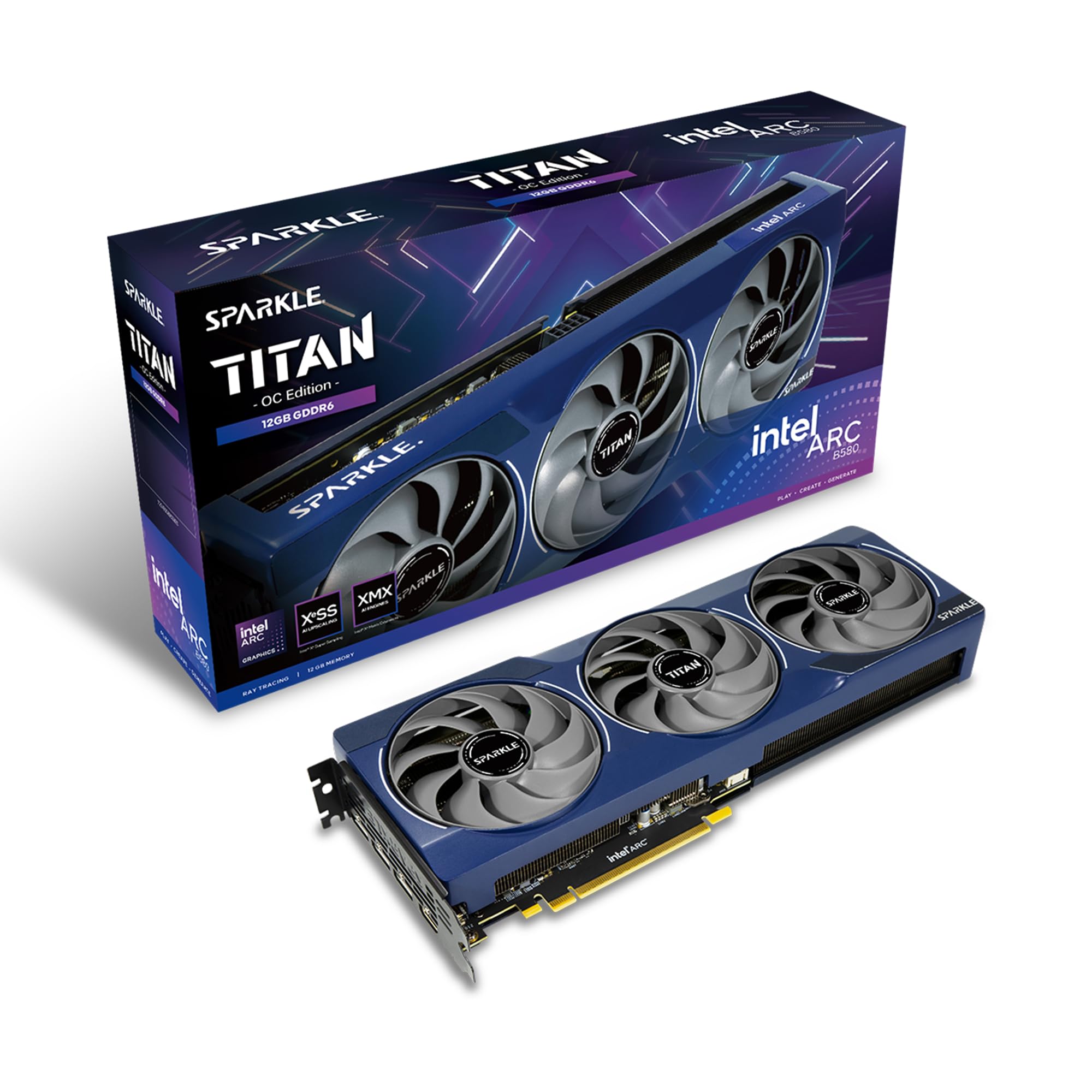
The card that made Intel a real third option in the discrete GPU market. 12 GB of VRAM at $250, ray tracing that works, XeSS 2 upscaling competitive with FSR 4, and drivers that have caught up to the hardware.
- 12 GB VRAM at the budget tier means modern textures actually load
- XeSS 2 quality is now within driver-update distance of DLSS
- Drivers have matured; Day-1 launches in 2026 run without major issues
- Cheaper than RTX 4060 and RX 7600 with better specs
- Compute throughput trails RTX 5060 Ti in heavily compute-bound titles
- Edge-case driver issues remain in some older DX11 games (Civ V, etc.)
- Resale value is still soft; not great for upgrade-and-resell users
Two years ago, recommending an Intel GPU was a bet on potential. Today it's the right answer at the budget tier. The B580 has 12 GB of GDDR6 versus 8 GB on the RTX 4060 and RX 7600 at the same price; in modern titles that hit VRAM ceilings (Indiana Jones, Stalker 2, Hogwarts Legacy) the extra capacity is the difference between playable and a slideshow. XeSS 2, Intel's upscaler, matches FSR 3 quality and is closing on DLSS 3. Driver maturity was the bet in 2024; the bet paid off in 2025, and by 2026 the only games that misbehave on Arc are pre-2015 DX11 titles few people in the budget-card audience are playing. The RTX 5060 Ti 16 GB is a stronger card overall but costs $200 more. For 1080p gaming and light 1440p, the B580 is the buy.
MSI Ventus 3X GeForce RTX 5080
Blackwell · 16 GB GDDR7 · 10752 CUDA cores · 360 W · 12V-2x6
The GPU to buy if you want 4K at high settings without going to splurge tier. DLSS 4 with Multi Frame Generation is the differentiator versus the 9070 XT; the gaming performance gap to the RTX 5090 is 30-40 % but the cost gap is half that.
- DLSS 4 + Multi Frame Generation is a genuine 4K gaming advantage
- 16 GB GDDR7 with much higher bandwidth than GDDR6X
- Best price/performance NVIDIA card for 4K under $1,500
- CUDA + tensor cores for any work-adjacent compute load
- 16 GB VRAM is the floor for 4K-with-mods in 2026, not the ceiling
- 12V-2x6 connector requires careful seating; budget for a quality cable
- $999 MSRP is fiction; expect $1,100-1,300 actual
For 4K gaming under $1,500, the RTX 5080 is the answer almost without competition. The 9070 XT and 5070 Ti both struggle to hit consistent 4K-high-with-RT framerates; the 5080 clears that bar with DLSS 4 Quality mode active in most modern titles. Multi Frame Generation pushes effective frame rates 2-3x in supported games, which is the entire reason for picking NVIDIA at this tier over the cheaper AMD card one rung down. The 16 GB VRAM is the only point of long-term concern: 4K with high-res texture mods or future AAA releases can saturate 16 GB, and the RTX 5090's 32 GB matters more if you intend to keep the card past 2028. For now, in May 2026, the 5080 is the correct buy under $1,500.
ASUS TUF Gaming GeForce RTX 5090
Blackwell · 32 GB GDDR7 · 21760 CUDA cores · 575 W · 12V-2x6
The current ceiling of consumer GPUs. 32 GB GDDR7 is the headline; it's also the reason this card matters beyond pure gaming, where local LLM inference and Stable Diffusion workloads have outgrown 24 GB cards.
- 32 GB VRAM unlocks local AI inference and Stable Diffusion at competitive quality
- No consumer card touches it in 4K with full ray tracing
- DLSS 4 + Multi Frame Generation is unbottlenecked on this hardware
- Resale floor stays high because of the AI/ML demand outside gaming
- $1,999 MSRP is also fiction; expect $2,200-2,800 actual
- 575 W TBP usually means a PSU upgrade for builds under 1,000 W
- Gaming-only buyers get 30 % more frames for 80 % more money vs. the 5080
- 12V-2x6 connector failure stories continue; seat it carefully
Whether the 5090 is worth $1,000 more than the 5080 depends on whether you do any work other than gaming. For pure 4K gaming, the answer is no; 30-40 % more frames for nearly double the cost is a poor value calculation. For anyone running local AI inference (32 GB unlocks 30B-parameter models in 4-bit, 70B in 2-bit), Stable Diffusion XL with full-resolution outputs, Blender renders that benefit from CUDA + the extra VRAM, or 4K + heavy texture mods, the 5090 is the only card that gets the job done in one chassis without going to professional Quadro / RTX A-series money. Budget for a 1,000 W PSU at minimum (1,200 W with safety margin) and a case with strong front-to-back airflow.
The numbers.
| RX 9070 XT | Arc B580 | RTX 5080 | RTX 5090 | |
|---|---|---|---|---|
| Architecture | RDNA 4 | Xe2 Battlemage | Blackwell | Blackwell |
| VRAM | 16 GB GDDR6 | 12 GB GDDR6 | 16 GB GDDR7 | 32 GB GDDR7 |
| TBP | 304 W | 190 W | 360 W | 575 W |
| Power connector | 2 × 8-pin | 1 × 8-pin | 12V-2x6 | 12V-2x6 |
| Best resolution | 1440p / entry 4K | 1080p / 1440p | 4K | 4K + heavy |
| Ray tracing | Strong | Solid | Excellent | Reference |
| Upscaler | FSR 4 | XeSS 2 | DLSS 4 + MFG | DLSS 4 + MFG |
| Street price (May 2026) | $700-800 | $280-330 | $1,100-1,300 | $2,200-2,800 |
| PSU recommended | 750 W | 550 W | 850 W | 1,000 W+ |
Other strong options.
ASUS Prime GeForce RTX 5070 Ti
The NVIDIA-lane sweet spot. Matches the RX 9070 XT in most raster scenarios and beats it in ray tracing by 10-15 %, but costs $80-150 more. The pick if DLSS 4 Multi Frame Generation matters more than the price gap, or if CUDA is in your workflow.
View on Amazon →MSI Ventus GeForce RTX 5070
12 GB VRAM is the catch; everything else is solid 1440p performance for $549-650. The pick if you want NVIDIA features (DLSS 4, CUDA) at a price below the 9070 XT, and you can live with 12 GB through the next two years.
View on Amazon →MSI Ventus 2X RTX 5060 Ti 16 GB
The 16 GB version of the 5060 Ti; do not buy the 8 GB version. Solid 1440p card at $450-550 with DLSS 4 and the 16 GB cushion. Slower than the RX 9070 by 10 % in raster but with the full NVIDIA software stack.
View on Amazon →Sapphire Pulse Radeon RX 9070
The cheaper sibling of the 9070 XT, $50-100 less for ~15 % less performance. The pick if the 9070 XT prices are inflated and you want the same 16 GB GDDR6 and RDNA 4 features at a lower cost.
View on Amazon →ASUS ProArt GeForce RTX 4070 Super
The last-gen NVIDIA value play. Still in stock at $500-600 in May 2026, performs within 5-10 % of the RTX 5070 in raster, and has DLSS 3.5 (no Multi Frame Gen). The pick if 5070 prices are inflated above $650 and you can find a 4070 Super on sale.
View on Amazon →Sapphire Nitro+ Radeon RX 7900 XTX
24 GB VRAM at the 9070 XT's price. RDNA 3, so ray tracing is weaker than RDNA 4, but raw raster is competitive with the RTX 5080 in non-RT workloads. The pick if you want maximum VRAM under $900 for content creation or texture-heavy gaming.
View on Amazon →Sapphire Pulse Radeon RX 7800 XT
The last-gen 1440p value play. $450-550 with 16 GB VRAM, within 15 % of the 9070 in raster, no ray tracing competitiveness. The pick if you find one for under $450 and don't care about RDNA 4 improvements.
View on Amazon →Sapphire Pulse Radeon RX 7600
The cheaper budget alternative if Arc B580 stock is out. 8 GB VRAM (the limitation), $230-280, solid 1080p. Avoid for 1440p or anything that touches modern texture-streamed engines.
View on Amazon →The buying guide.
Buy now or wait
The shortest defensible answer in May 2026 is: buy if you need a card, wait if you don't. Tariffs are unlikely to drop before Q4 2026 based on current political signaling. RTX 50-series is mid-life; no refresh expected until late 2026 or 2027. AMD's RDNA 4 lineup is complete. Intel's Arc Celestial (B-series successor) is rumored for late 2026 but not confirmed. The market won't get cheaper or better in the next 6 months. If you're sitting on a working card, ride it out. If you're building a new system, buy now.
NVIDIA vs AMD vs Intel
At each price tier in 2026: NVIDIA's advantages are DLSS 4 + Multi Frame Generation (real in supported games), the CUDA ecosystem (essential for any work-adjacent compute), and resale value. AMD's advantages are price-per-frame in raster, more VRAM per dollar, and no 12VHPWR melting risk. Intel's advantage is the budget tier; at $250-300, the Arc B580 has 12 GB of VRAM no NVIDIA card under $500 matches. For pure gaming under $500, Intel. For pure gaming $500-900, AMD. For gaming + any compute work, NVIDIA. For 4K gaming + AI/ML workloads, NVIDIA splurge tier (RTX 5090).
VRAM rules of thumb
In May 2026, the floor is 12 GB. Below 12 GB, modern texture-streamed engines (anything UE5, Stalker 2, Indiana Jones, Hogwarts Legacy with mods) will run out of VRAM at 1440p settings. 16 GB is comfortable for 1440p and entry-level 4K. At 4K with texture mods or for content creation, you'll want 24 GB. 32 GB is the AI/ML threshold for running 30B-parameter language models locally at usable quality.
PSU and case clearance
Each tier requires a PSU bump. RTX 5090 is 575 W TBP and needs a 1,000 W PSU with proper 12V-2x6 cabling (don't use included adapters; buy a native cable from Cablemod, Corsair, or your PSU manufacturer). RTX 5080 is 360 W; 850 W PSU recommended. RX 9070 XT is 304 W; 750 W is enough. Arc B580 at 190 W runs off any modern 550 W+ PSU. For case clearance: most current-gen cards are 320-360 mm long; mid-tower ATX is fine, mini-tower or compact ITX needs the 2.5-slot or short PCB versions (PNY, Gigabyte Aero, MSI Ventus 2X).
The used market
The used GPU market in May 2026 is the strongest value lane that exists. RTX 4070 Super and 4080 Super, RX 7900 XT / XTX, and RX 7800 XT all hold the same gaming performance they had in 2024 and frequently sell at 60-70 % of MSRP on eBay or r/hardwareswap. The only catch: inspect 12VHPWR-equipped cards (RTX 4080, 4090) for connector damage before buying. For pre-12VHPWR cards (everything AMD, NVIDIA 3000-series and below), used is the better-value tier and we recommend it for buyers who don't need the latest features.
FAQ.
In supported titles, yes. Multi Frame Generation produces 2-3x effective frame rates with image quality that's better than FSR 4's frame generation at the same setting. The catch is that fewer than 50 % of new releases support MFG yet; for unsupported titles, DLSS 4 Quality mode and FSR 4 Quality are close enough that the price gap (RTX 5070 Ti vs RX 9070 XT, etc.) doesn't justify the NVIDIA tax purely for upscaling.
In raster: a wash, slight edge to the 9070 XT in some titles, slight edge to the 5070 Ti in others. In ray tracing: 5070 Ti wins by 10-15 % in heavy RT titles. In price: 9070 XT runs $80-150 cheaper at retail. The 9070 XT wins on value; the 5070 Ti wins on features. For gaming-only buyers, 9070 XT. For mixed-use, 5070 Ti.
Not before Q4 2026 based on current trade policy signaling. The 10-30 % uplift on Chinese-assembled GPUs is the new baseline. Cards assembled in Taiwan or US-based partner facilities (some MSI, Sapphire, and EVGA SKUs are reportedly Taiwan-assembled) are less affected; verify on the box if this matters to you.
Almost certainly. The 5090 is 575 W TBP; transient spikes peak above 700 W. A 1,000 W PSU is the recommended minimum; 1,200 W gives headroom for a 9800X3D or 285K CPU plus the card. Use a native 12V-2x6 cable from the PSU manufacturer, not the included adapter. Cablemod's recall in 2024 was a real safety issue; don't cheap out here.
Both are excellent value in May 2026. The 4070 Super sells used at $400-500 for performance within 10 % of an RTX 5070. The RX 7900 XTX at $700-800 used is the highest-VRAM (24 GB) sub-$1,000 option that exists. Stick to private sellers with photos of the 12VHPWR connector if applicable (4080/4090), or stick to AMD where the connector is the standard 8-pin and the risk is lower.
Sweet spot: the RX 9070 XT.
Budget: the Arc B580.
High-end: the RTX 5080.
Splurge: the RTX 5090.
The May 2026 market is the strangest GPU buying environment since the crypto era. Tariffs, the RAM crisis, and three credible vendors at every price tier mean the right buy depends on which tier you sit in and what you do with the card. For most builders we'd point to the RX 9070 XT and stop thinking; for AI / 4K maximum settings, the 5090. Skip the RTX 5060 8 GB and any 8 GB card going forward; the VRAM floor has moved.